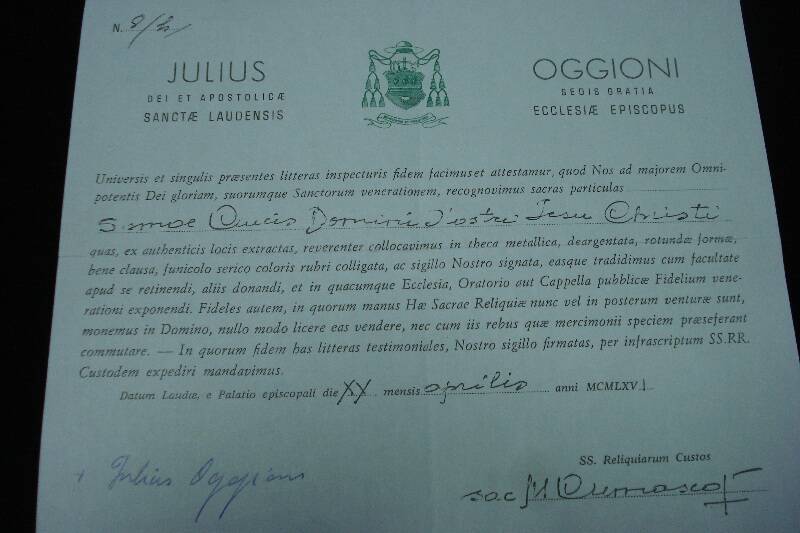
Fake relics post 2
a long long time ago there was a website devoted to relics, the proprietor has long gone, but some of his information is still accessible and we will post stuff from it from time to time .... here is one of those files
Just Arrived from Costa Rica via Mexico
November 3, 2012
A correspondent in Juarez, Mexico, sent me a series of images this morning he had received from friends in Costa Rica. They wanted a relic of the True Cross examined for authenticity. Unfortunately, all of the images of the theca and seal were extremely blurry and of no help. However, additional images were not required here as the document itself condemns the relic to the trash pile. My Latin skills are poor, the last class I had was in my sophomore year of high school MANY years ago, so I can't comment on how proper or improper the wording of the document is. What shows this to be a fake is the date of the document. The relic was, supposedly, prepared in 1966 by Bishop Giulio Oggioni. One little mistake that this counterfeiter did make - Giulio Oggioni was not consecrated bishop until 1972. It took a five minute GOOGLE search to find that information. What a valuable resource we have in the Internet! Keep your eyes open as there are bound to be more of these floating around.
Check it for yourself here!
Update - I just had a message from our Mexican correspondent. His source says the "relics" originated in Italy and have appeared in Mexico, Costa Rica, Argentina and Peru.
November 7, 2012, update - Two days ago I received an email from a Franciscan brother in Venezuela along with some fuzzy images of an identical "relic" of the True Cross and he wanted to confirm its authenticty. I gave him the bad news and told him to either 1.) turn the relic and document over to law enforcement for prosecution or 2.) completely destroy the "relic" and document so that it does not end up being venerated or end up being recycled back into the criminal trade in relics.
Why are some relics and their documents in much better shape than others?
The answer is easy and sometimes a bit complex
The paper used - the best paper wasn't always used from the 1860 ies wood pulp started to make it's way in the paper pulp industry. And wood paper is acid thus damaging the paper with browning and detoriation.
Some documents still look great despite the wood pulp, reason because the document was kept in a safe environment without cigarette or cigar smoking
The oldest ones from the late 18th century till the midfifties from the 19th century look better then the recent ones
The best looking ones are ofthen the ones from the early 20-30-40 ies + why because they aren't that old decay hasn't set in.
Isn't it dangerous to buy a document which has started to brown, no as long as you keep it safe it will stay more or less the same, also don't handle it every 5 minutes of the deay again decay will continue
Pouch/ small paper enveloppe relics
Before a relic goes into a theca or another holder it needs to get to the convent or to whoever made the relic , meaning the placement into it's holder and afterwards sealing with the episcopal seal and wax, so the items were packaged into small Paper pouches, these pouches were then sealed with a wax stamp from the bishop or the convent. In the case of the convent seal it's mostly because the convent owned a big relic of the Saint, and then it was distributed to other convents in small sealed packages. Many convents had a small stock of these to be used in Future commisions. Sometimes these Paper enveloppes were also given away or sold to People without it being placed in a new container. We have bought up many relic collections throughout the years and many had these parcels. None of these had any documentation and most never had this, we suspect because it was primarily for use for convents and they Knew where it Came from.
Fake relics post 1
a long time ago a webpage existed which gave information on fake relics, we had this in our saved pages, but then it dissappaered, we found back the information and will post it here, this gives you insightfull information
Charles Albert Lecomte was bishop of Amiens (France) in the 1930s. As with the Ferrante documents, the Lecomte documents have also been used to accompany fake relics. Shown to the left is a typical fake relic and fake document that was produced by scam artists. The document is dated 1931. However, the theca described in the document was produced by the company Fonderia Zafo in Italy. The company was founded in the late 1970s and did not start to produce these thecas until several years later. This writer contacted the company in Italy and verified that the theca was, indeed, produced by them. Some of these fakes came with documents dated after the year 1934, the year in which Bishop Lecomte passed away.
Numerous fake relics such as these surfaced suddenly in the year 2006, all of them from one dealer based in the United States. When confronted with this evidence the dealer did refund money to those who requested it if the "relics" were returned. He then proceeded to sell the same relics again but without the incriminating documents.
